
What Are High Ticket Sales?
High ticket sales refer to the sale of premium products or services with a significant price tag, usually starting from around $1,000 and ranging up to $50,000 or more for enterprise deals. Common examples include coaching programs, consulting services, real estate transactions, and enterprise software solutions.
What truly defines a high ticket sale isn’t the price tag alone — it’s the complexity, the relationship, and the stakes involved on both sides. Buyers don’t make these purchases impulsively. They take time to evaluate options, compare value, and ensure they’re making the right investment. The focus shifts from transaction volume to consultative selling, trust-building, and personalized buyer journeys.
This guide breaks down what makes high ticket sales different, the strategies that actually close these deals in 2026, and the common mistakes that cause otherwise promising deals to stall.
How High Ticket Sales Differ From Low-Ticket Selling
A low-ticket sale is a quick, low-risk purchase decision — often made within minutes, sometimes without ever speaking to a human. High ticket sales operate on an entirely different timeline and dynamic.
The sales cycle takes significantly longer. A deal that closes in a day at a low price point can take anywhere from four to twelve weeks — and for enterprise deals, high ticket sales cycles often run sixty to one hundred eighty days on average, with multiple stakeholders involved on the buyer side.
Trust decides everything in high ticket sales. The buyer is evaluating the seller just as much as the product itself — how fast you respond, how well you understand their situation, and how organized your process feels from the very first touchpoint. If that trust is missing, the deal simply will not move forward, regardless of how strong the product is.
Research shows that most B2B sales involve an average of six to ten decision-makers, and engaging multiple stakeholders can raise deal close rates by up to thirty percent. This complexity is why stakeholder mapping and personalized outreach become critical at the high ticket level in a way they simply aren’t for smaller transactional sales.
Why High Ticket Deals Stall (And It’s Rarely the Product)
Eight out of ten high ticket deals stall not because the buyer said no, but because the seller stopped leading the conversation. Across B2B sales teams, agencies, and founders running outbound, the same patterns keep showing up.
The seller pitches the wrong person inside the company, someone without real decision-making authority. The follow-up comes too late, and by the time it lands, the buyer has already moved on or lost urgency. The first meeting ends without a clear next step, leaving both sides unsure of what happens next. The pitch focuses on features rather than buyer outcomes, failing to connect the product to what the buyer actually cares about. And often, nobody shows the buyer what inaction is actually costing them — the cost of staying with the status quo.
None of these are product problems. They’re process problems — and each one can be fixed with the right approach.
Strategy 1: Build Trust Before You Pitch
Despite the analytical surface of high ticket decisions, they are deeply emotional. Buyers may say they need a better CRM, a marketing consultant, or new software, but what they truly want is control, credibility, or peace of mind.
To close high ticket sales consistently, sellers must create a decision environment built on trust, clarity, and perceived transformation. This means every conversation becomes more strategic and every touchpoint more scrutinized than it would be in a low-ticket sale. Peer-reviewed research confirms that higher levels of interpersonal trust between buyer and seller directly correlate with improved sales process efficiency and stronger long-term customer relationships.
Practically, this means your first few touchpoints — whether emails, calls, or content — should focus on demonstrating genuine understanding of the buyer’s situation before any product pitch happens at all.
Strategy 2: Qualify Ruthlessly
Not every prospect deserves the time investment that high ticket sales require. Spending weeks nurturing a deal that was never going to close drains both time and momentum from deals that could actually move forward.
Effective qualification means identifying early whether a prospect has a real, pressing problem, the authority or access to decision-makers needed to act on it, and a budget that realistically aligns with your offer. The goal isn’t to disqualify aggressively — it’s to direct your limited time toward conversations that have a genuine path to becoming a deal.
Strategy 3: Run a Structured Discovery Call
The discovery call is where most high ticket deals are won or lost — long before any formal pitch happens.
Structured questioning frameworks consistently outperform free-flowing conversation. A landmark study of over 35,000 sales calls found that aggressive closing techniques actually hurt conversion in complex deals, while structured questioning lifted close rates by twenty percent.
One widely used framework is SPIN — Situation, Problem, Implication, Need-payoff questions — which guides the conversation from understanding the buyer’s current situation through to helping them articulate the value of solving their problem. For shorter sales cycles, a Micro-SPIN variant works well: one concise situation question, followed by a sharp problem question, moving more quickly toward implications and needs.
During discovery, the goal is to listen more than you talk. Many high-performing reps aim to listen for the majority of the call — often cited around 57% of talk time going to the prospect — while asking questions that surface real pain points rather than surface-level “nice to have” responses.
A practical tip: build a bank of strong discovery questions and keep them accessible in your CRM notes, so you’re consistently pulling out the kind of context that makes later stages of the deal far easier.
Strategy 4: Multi-Thread Across the Buying Committee
Single-threading — relying on just one contact inside an organization — is one of the most common reasons high ticket deals quietly die. The champion you’ve been talking to might leave the company, get reassigned, or simply lose internal influence on the decision.
Multi-threading means engaging multiple stakeholders within the buying committee, typically three to five contacts at minimum for any meaningful deal size. A practical approach is to start with the “doer” — the person who would actually use the product day-to-day — and then move up the chain to economic buyers and other influencers as the relationship develops.
A related tactic sometimes called “Book A Meeting From A Meeting” involves using an existing conversation as a bridge to secure introductions to other relevant stakeholders, rather than trying to reach each person cold and separately.
Strategy 5: Build Authority With Short, Relevant Proof
In high ticket sales, buyers are constantly asking themselves whether this seller and this solution can actually deliver the transformation being promised. Generic case studies and broad testimonials rarely move the needle.
What works better is short, highly relevant proof — a brief example of a similar company, in a similar situation, achieving a similar outcome. The relevance matters more than the scale. A buyer evaluating a $20,000 solution wants to see evidence that closely mirrors their own context, not just an impressive logo wall.
Strategy 6: Sell on Value and Outcomes, Not Features
When you sell something at a high price point, you’re no longer competing on features. You’re competing on clarity, conviction, and the buyer’s belief that your offer is the best route to a transformation or return on investment.
This means the conversation should center on what changes for the buyer — reduced costs, increased revenue, time saved, risk eliminated — rather than a list of capabilities. By bridging emotional resonance (how the buyer will feel once the problem is solved) with logical justification (the numbers that support the decision), sellers help prospects commit with both heart and mind.
A particularly effective technique is making the cost of inaction explicit. Many deals stall simply because nobody ever clearly laid out what staying with the status quo is actually costing the buyer — in dollars, time, or missed opportunity.
Strategy 7: Build a Real Follow-Up System
The discovery call goes well. The prospect says all the right things. Then comes silence — sometimes for over a week.
If you’re trying to figure out how to close high ticket sales consistently, this pattern is the core problem to solve. Modern B2B deals require roughly sixty-two touches across three or more channels just to reach a signature, and roughly eighty percent of sales require at least five follow-ups — yet most reps quit after just two.
High ticket closing isn’t a single moment. It’s a system that includes a discovery framework, an objection-handling method, and a follow-up cadence that doesn’t quit after one email. One useful objection-handling approach follows a Validate, Isolate, Reframe pattern: acknowledge the concern as legitimate, isolate it as the specific thing standing in the way (rather than a vague “I need to think about it”), and then reframe it in light of the outcomes already discussed.
Common Stages of a High Ticket Sales Process
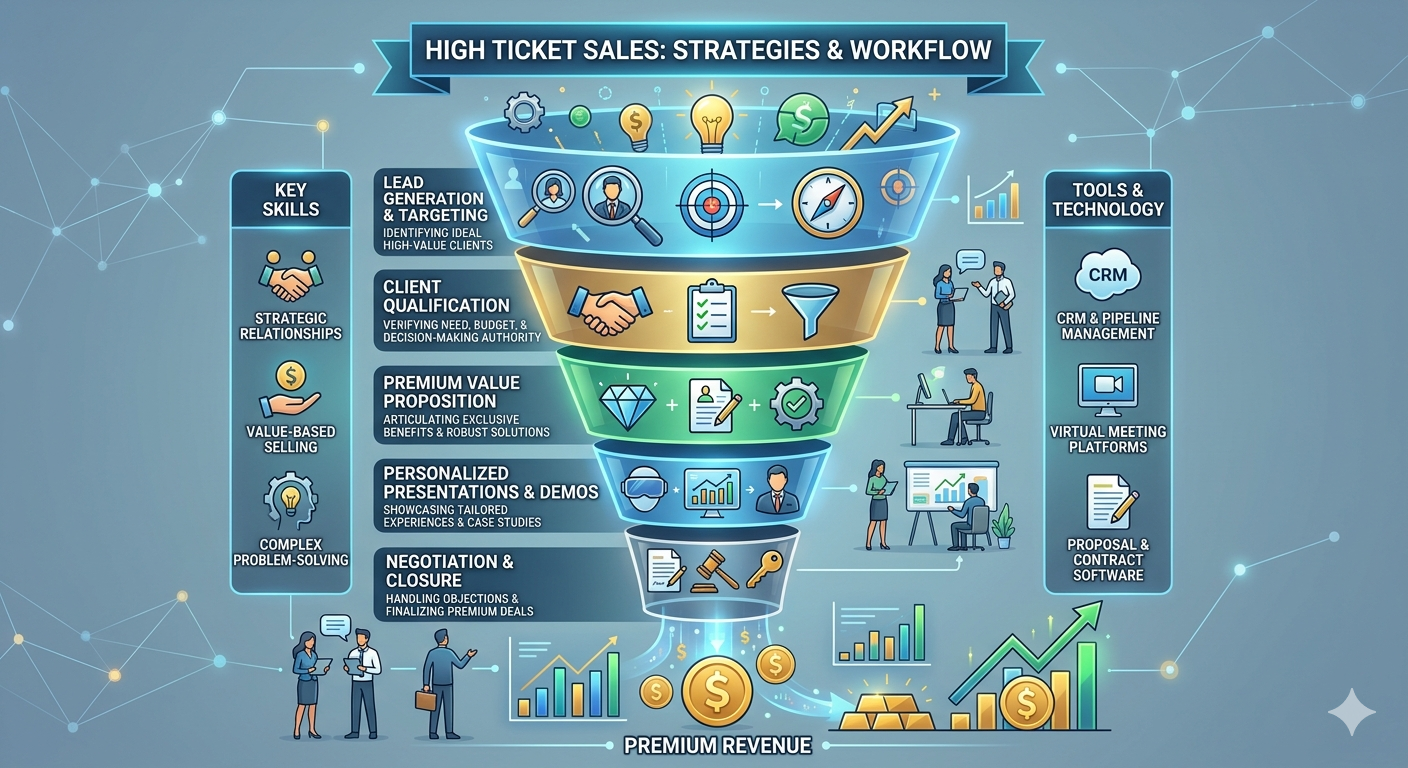
While every business adapts its process, most high ticket sales journeys follow a similar arc.
The process typically begins with targeted outreach to verified decision-makers, since reaching the wrong person inside an organization wastes the entire cycle before it even begins. This is followed by a discovery call that functions as genuine research rather than a sales pitch — the goal is understanding, not persuasion.
From there, sellers typically build a tailored proposal or business case that reflects what was learned during discovery, often involving a return visit to additional stakeholders identified through multi-threading. A presentation or demo follows, focused on the specific outcomes that matter to this buyer rather than a generic walkthrough.
Negotiation and objection handling come next, often spread across multiple conversations rather than resolved in a single call. Finally, the close itself should function as a confirmation of a decision the buyer has already arrived at through the process — not a persuasion event. If the seller is still “selling” at this stage, leverage has likely already been lost.
Common Challenges in High Ticket Sales
Long sales cycles create pressure on pipeline management, since deals can sit in progress for months without generating revenue, making forecasting more difficult than in transactional sales models.
Multiple decision-makers mean that internal politics, competing priorities, and changes in personnel can all affect a deal’s trajectory in ways a single seller can’t fully control.
Maintaining momentum across a long cycle requires discipline. Without a structured follow-up system, even genuinely interested buyers can simply drift away as other priorities take over their attention.
Finally, differentiating on value rather than price becomes harder as deal size increases, since larger purchases often involve formal procurement processes that can flatten nuanced value propositions into simple comparison spreadsheets.
FAQs About High Ticket Sales
Q1: What price range counts as a “high ticket” sale?
High ticket sales generally refer to products or services priced above $1,000, though the exact threshold varies by industry and region. In B2B and enterprise contexts, high ticket deals commonly range from a few thousand dollars up to $50,000 or more.
Q2: How long does a high ticket sales cycle typically take?
High ticket sales cycles are significantly longer than low-ticket purchases. While a low-cost product might be bought within minutes, high ticket deals often take four to twelve weeks, and for larger B2B or enterprise deals, the cycle can run sixty to one hundred eighty days or longer.
Q3: Why do high ticket deals stall after a good discovery call?
The most common reason is an inadequate follow-up system. Modern B2B buying often requires dozens of touchpoints across multiple channels before a decision is reached, and most sellers stop following up far too early — often after just one or two attempts — while the buyer’s interest, though genuine, simply fades without continued engagement.
Q4: What is multi-threading in high ticket sales, and why does it matter?
Multi-threading means engaging multiple stakeholders within a buyer’s organization — typically three to five contacts — rather than relying on a single point of contact. It matters because relying on just one champion is risky; if that person leaves, gets reassigned, or loses influence, the entire deal can collapse with no warning.
Q5: Should I focus on features or outcomes when selling high ticket products?
Outcomes. At higher price points, buyers are less focused on comparing feature lists and more focused on the transformation, ROI, or problem resolution your offer provides. Framing conversations around what changes for the buyer — financially, operationally, or emotionally — tends to be far more persuasive than a technical feature walkthrough.
Q6: What sales framework works best for high ticket discovery calls?
Structured questioning frameworks like SPIN (Situation, Problem, Implication, Need-payoff) have been shown to outperform unstructured conversation, with research linking structured questioning to meaningfully higher close rates. For shorter sales cycles, a condensed “Micro-SPIN” approach can work well — moving more quickly from situation to problem and implication.
Q7: How do I handle objections in high ticket sales without sounding pushy?
A useful approach is Validate, Isolate, Reframe — first acknowledge the buyer’s concern as legitimate, then isolate exactly what the underlying objection is rather than accepting a vague response, and finally reframe the objection in the context of the outcomes already discussed earlier in the process.
Q8: How many decision-makers are typically involved in a high ticket B2B sale?
Research indicates that most B2B sales involve an average of six to ten decision-makers. Engaging multiple stakeholders rather than a single contact has been linked to close rate improvements of up to thirty percent.
Q9: What’s the biggest mistake sellers make when closing high ticket deals?
Treating the close as a persuasion event rather than a confirmation. If a seller is still actively “selling” during what should be the closing conversation, it usually means trust and clarity weren’t fully established earlier in the process — and at that point, leverage has often already been lost.
Q10: Is high ticket sales a good fit for every business?
High ticket sales tends to work best for businesses with a product or service that delivers clear, demonstrable ROI and a team capable of conveying that value through a consultative process. It’s less about price alone and more about whether the offer justifies a longer, relationship-driven sales approach rather than a high-volume transactional model.
More From Our Blog
If you found this article helpful, you might also enjoy exploring more content from our blog. We regularly publish guides, tips, and insights across a variety of topics to help you stay informed and make better decisions. Feel free to check out our other articles and let us know what you’d like us to write about next.