
Is 20/20 Vision Actually “Perfect” Vision?
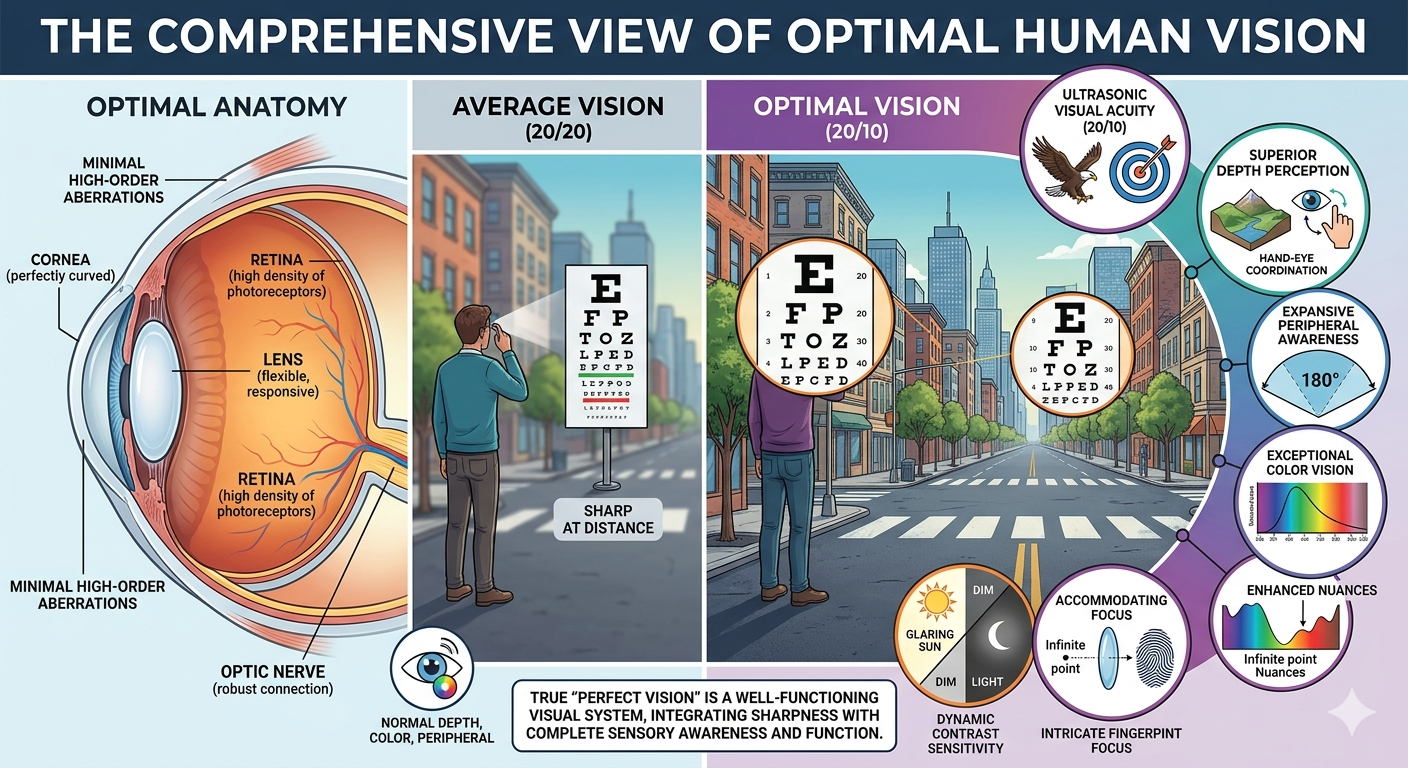
Most people assume 20/20 vision is as good as eyesight gets, but that’s a common misconception. Many people erroneously think that perfect vision is 20/20 vision, but that is not the case — 20/20 vision is actually considered “normal,” not perfect. True perfect vision is generally defined as 20/15 or 20/10 vision, paired with the absence of any other eye conditions.
This distinction matters because 20/20 simply represents the baseline standard most eye exams are measured against, not the upper limit of human visual capability. Plenty of people, particularly children and younger adults with healthy eyes, naturally test better than this baseline.
How Visual Acuity Is Actually Measured
Visual acuity refers to the clarity or sharpness of your vision, including your ability to recognize small details with precision, and it’s one of the first tests performed during a comprehensive eye exam. The standard tool for this is the Snellen eye chart, which doctors use to calculate your results as a fraction, such as 20/20 or 20/40.
The first number in this fraction represents the distance you’re standing from the chart, typically 20 feet. The second number represents the distance at which a person with normal vision could read that exact same line clearly. So a result of 20/40 means that at 20 feet, you can only see what someone with normal vision could see clearly from 40 feet away — meaning your distance vision is below average. A result of 20/10, on the other hand, means you can see at 20 feet what an average person would need to stand just 10 feet away to see clearly — meaning your distance vision is sharper than average.
What Is 20/10 Vision, and Is It the Best Possible?
20/10 vision is widely considered to be at or near the maximum visual acuity achievable by human eyes without the help of binoculars or other magnifying devices. Someone with this level of acuity can clearly read the smallest line on a standard eye chart and see fine detail from twice the distance an average person would need.
While 20/10 represents an exceptional level of sharpness, it’s worth noting that even sharper results have occasionally been documented. One frequently cited example involves an Aboriginal Australian man whose tested visual acuity reached an extraordinary 20/5, generally regarded as among the sharpest human vision ever formally recorded. Cases like this are extremely rare exceptions rather than something achievable through typical correction or training.
How Common Is Better-Than-Average Vision?
Despite how often people casually claim to have “perfect 20/20 vision,” truly exceptional eyesight is less common than most assume. According to the American Academy of Ophthalmology, only about 35% of adults have 20/20 vision without any corrective lenses such as glasses or contacts. Even when corrective lenses are factored in, only about 75% of adults achieve 20/20 vision with correction.
Vision better than 20/20, such as 20/15 or 20/10, is comparatively rare and tends to be more common in younger people, particularly children and teenagers with healthy, fully developed eyes that haven’t yet experienced the natural age-related changes that commonly affect visual acuity later in life.
Why Visual Acuity Isn’t the Whole Picture
It’s tempting to treat a single eye chart number as the definitive measure of “how good” someone’s vision is, but visual acuity is only one component of overall visual function. A comprehensive eye exam also evaluates several other factors that meaningfully affect how well a person actually sees and functions in daily life.
Peripheral vision, the ability to see objects outside your direct line of sight, plays an important role in awareness and safety, particularly while driving. Depth perception, your ability to judge distances accurately, depends on both eyes working together effectively. Color vision determines whether you can accurately distinguish between different colors and shades. Eye coordination affects how smoothly your two eyes work together to produce a single, clear image, while focusing ability determines how quickly and accurately your eyes can adjust between near and distant objects.
Because of this, it’s entirely possible for someone to test at 20/20 or even better on a basic acuity chart while still experiencing real difficulties with depth perception, peripheral awareness, or focusing speed. Conversely, someone with technically below-average acuity, such as 20/40, might have excellent depth perception and focusing ability that more than compensates in real-world situations. True “perfect” vision, in the fullest sense, would require strong results across all of these categories, not just a single sharp reading on an eye chart.
Can You Achieve 20/10 Vision Through Correction?
For people who don’t naturally have ultra-sharp eyesight, several corrective options can bring vision closer to, or in some cases to, the 20/10 level.
Prescription Eyeglasses
Glasses work by helping focus light correctly onto the retina to correct refractive errors like nearsightedness, farsightedness, or astigmatism. Some people who wear specially fitted glasses report achieving vision as sharp as 20/15 or even 20/10. Eyeglasses offer the advantage of not requiring any surgery, while also providing a layer of physical protection for the eyes, and they’re generally more affordable than other correction methods.
Contact Lenses
Contact lenses sit directly on the eye’s surface and can offer better peripheral vision compared to glasses, since they move naturally with the eye and aren’t limited by a frame. Like glasses, contacts can be fitted to provide sharper-than-average correction for some patients, depending on their specific eye structure and refractive error.
Laser Eye Surgery (LASIK)
LASIK permanently reshapes the cornea to correct refractive errors, addressing nearsightedness, farsightedness, and astigmatism through a quick procedure, typically performed under local anesthetic eye drops and lasting only 20 to 30 minutes per eye. According to the American Refractive Surgery Council, more than 99% of LASIK patients achieve better than 20/40 vision, and more than 90% achieve 20/20 vision or better. In the UK specifically, about 85% of laser eye surgery patients end up with 20/20 vision or better following the procedure.
It’s worth noting that a prescription specifically targeting 20/10 distance vision will certainly sharpen far-away vision, but it may come with a trade-off, potentially compromising near vision in the process. This is an important consideration to discuss directly with an eye doctor rather than assuming sharper distance vision is automatically better for every situation.
Is It Worth Trying to Achieve 20/10 Vision?
While many people are drawn to the idea of having sharper-than-average eyesight, it’s worth keeping expectations realistic. Achieving 20/10 vision isn’t possible for everyone, regardless of which corrective method is used, since individual eye anatomy and underlying eye health ultimately set the limits of what correction can achieve.
It’s also worth considering whether this level of visual sharpness is actually necessary for your lifestyle. Most careers and daily activities don’t require visual acuity beyond standard 20/20 correction, and even in fields where excellent vision is genuinely important, evidence-based medical guidance, rather than the general goal of “sharper is always better,” should guide any decision about pursuing more aggressive correction.
Supporting Healthy Vision Naturally
While diet and lifestyle factors can’t dramatically reshape your baseline visual acuity, they do play a meaningful role in supporting overall eye health over time. A diet rich in antioxidants, including leafy green vegetables, is commonly recommended as part of supporting clear, healthy vision throughout life.
Beyond diet, routine comprehensive eye exams remain the most reliable way to track your visual acuity and catch any changes early, since several common eye conditions develop gradually and aren’t always noticeable through day-to-day experience alone.
FAQs About Best Possible Eye Vision
Q1: Is 20/20 vision the best vision possible?
No. 20/20 vision is considered “normal” or average vision, not the upper limit of human visual capability. Some people naturally have 20/15 or 20/10 vision, which is sharper than the 20/20 standard, and in extremely rare documented cases, vision has been recorded as sharp as 20/5.
Q2: What does 20/10 vision actually mean?
20/10 vision means that at 20 feet, you can see clearly what someone with average vision would need to stand just 10 feet away to see with the same clarity. It’s widely regarded as close to the maximum visual acuity achievable by human eyes without magnifying devices.
Q3: How rare is 20/10 vision?
It’s considered rare. While exact prevalence figures vary, most adults don’t naturally achieve this level of acuity, and it tends to be more commonly seen in children and younger people with fully healthy, undamaged eyes.
Q4: Can LASIK give you better than 20/20 vision?
Yes, for many patients. According to industry data, more than 90% of LASIK patients achieve 20/20 vision or better, and some patients do achieve 20/15 or 20/10 results, though outcomes vary based on individual eye anatomy and the specific refractive error being corrected.
Q5: Does having 20/20 or better vision mean you have perfect eyesight overall?
Not necessarily. Visual acuity, as measured by an eye chart, is just one component of overall visual function. Other factors, including peripheral vision, depth perception, color vision, and eye coordination, all contribute to how well someone actually sees in real-world situations, and a person can test well on acuity alone while still having issues in these other areas.
Q6: Is it better to have 20/10 vision than 20/20?
In terms of raw distance visual sharpness, yes, 20/10 is technically sharper than 20/20. However, for most people, 20/20 vision (with or without correction) is more than sufficient for daily life and most careers, and pursuing 20/10 specifically isn’t necessary or realistic for everyone.
Q7: What is the best human vision ever recorded?
One of the most frequently cited examples involves an Aboriginal Australian man with documented visual acuity of 20/5, considered among the sharpest human vision ever formally recorded. Cases at this level are exceptionally rare exceptions rather than a realistic benchmark for typical vision correction.
Q8: Can diet improve my visual acuity?
Diet alone is unlikely to dramatically change your baseline visual acuity, but a diet rich in antioxidants, including leafy greens, is commonly recommended to support overall eye health. For meaningful changes in visual acuity, corrective options like glasses, contacts, or LASIK, combined with regular eye exams, are the most reliable approaches.
More From Our Blog
If you found this article helpful, you might also enjoy exploring more content from our blog. We regularly publish guides, tips, and insights across a variety of topics to help you stay informed and make better decisions. Feel free to check out our other articles and let us know what you’d like us to write about next.