
What Is an Ovarian Cyst?
An ovarian cyst is a fluid-filled sac that develops on or within one of the ovaries. They are extremely common — most women will develop at least one during their lifetime — and the vast majority cause no symptoms at all and resolve on their own without any treatment. The cysts that do require treatment are generally those that are large, persistent, causing noticeable symptoms, or showing characteristics that raise concern for other conditions.
Ovarian cysts develop for a variety of reasons. Functional cysts, the most common type, form as a normal part of the menstrual cycle and almost always disappear within one to three menstrual cycles without intervention. Other types include dermoid cysts, which contain tissue such as hair or skin cells, cystadenomas, which develop from ovarian surface tissue, and endometriomas, which are associated with endometriosis. Understanding which type of cyst you have is an important first step in determining the most appropriate treatment approach.
How Are Ovarian Cysts Diagnosed?
Before any treatment decision is made, accurate diagnosis through imaging is essential. Most ovarian cysts are discovered during a routine pelvic examination or pelvic ultrasound, which is the primary imaging tool used to assess cyst size, location, and characteristics. For cysts with features that need further evaluation, an MRI or CT scan may be used to provide more detailed information about the cyst’s structure.
Blood tests including CA-125 tumor marker testing are sometimes used alongside imaging when there is any concern about the possibility of malignancy, particularly in postmenopausal women. A single elevated CA-125 result does not diagnose cancer — the test is most useful as part of a broader clinical picture — but it contributes important information when planning the most appropriate treatment path.
Treatment Option 1: Watchful Waiting (Expectant Management)
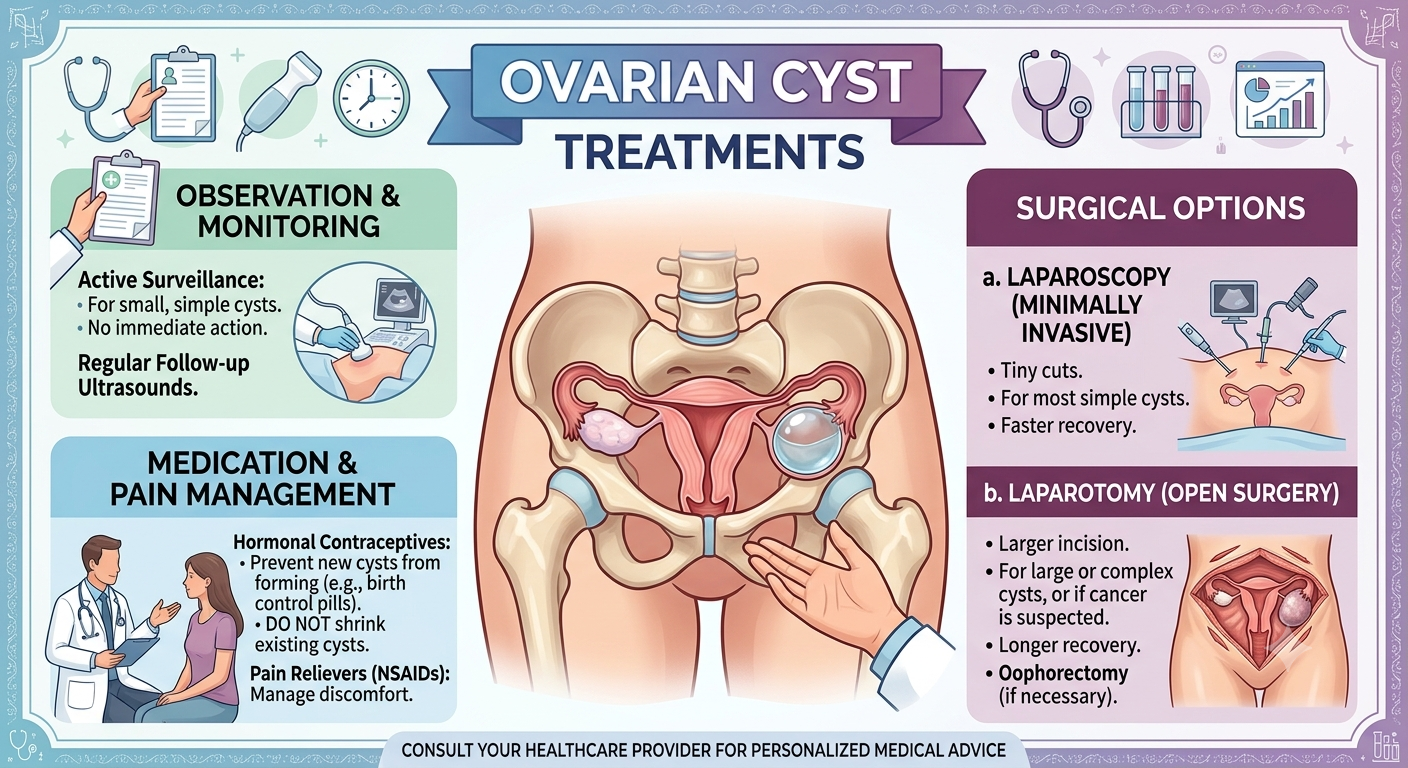
For the majority of ovarian cysts, particularly functional cysts discovered incidentally in premenopausal women, the recommended first step is watchful waiting rather than immediate intervention. This approach involves monitoring the cyst through periodic ultrasound examinations — typically at six to twelve week intervals — to track whether it resolves on its own, remains stable, or grows.
Watchful waiting is appropriate when the cyst is small, appears simple on ultrasound with no complex features, is not causing significant symptoms, and there are no concerning markers suggesting malignancy. Most functional cysts disappear completely within one to three menstrual cycles under this approach, which is why avoiding immediate intervention for appropriate cysts is genuinely evidence-based practice rather than simply deferring treatment.
The decision to move from watchful waiting to active treatment is typically triggered by cyst growth, persistence beyond three menstrual cycles, the development of symptoms, or changes in the cyst’s appearance on follow-up imaging.
Treatment Option 2: Pain Management for Symptomatic Cysts
For cysts causing discomfort or pain without yet meeting the criteria for surgical intervention, symptom management can significantly improve quality of life during the monitoring period. Over-the-counter pain relievers such as ibuprofen or naproxen are commonly used to manage pelvic discomfort associated with ovarian cysts, since their anti-inflammatory properties address both pain and the underlying inflammation that contributes to it.
Heat therapy applied to the lower abdomen or lower back can also provide meaningful relief during symptomatic periods and is frequently recommended alongside medication as a complementary approach. Avoiding intense physical activity during particularly symptomatic phases reduces the risk of aggravating the cyst and helps manage discomfort while waiting to see how the cyst progresses.
Treatment Option 3: Hormonal Therapy
Hormonal contraceptives, particularly combined oral contraceptive pills, are commonly prescribed in the context of ovarian cysts for several distinct purposes that are worth understanding clearly.
Hormonal birth control prevents ovulation, which in turn reduces the formation of new functional cysts. This makes it a useful option for women who experience recurrent functional cysts, since addressing the underlying mechanism of formation is more effective than repeatedly treating individual cysts as they appear.
However, an important and frequently misunderstood point is that hormonal treatment does not cause existing cysts to resolve more quickly. Current evidence indicates that hormonal contraceptives do not hasten the disappearance of cysts already present — their value in ovarian cyst management is primarily preventive rather than curative for cysts that have already formed.
For ovarian cysts associated with endometriosis, hormonal management plays a more direct treatment role. Endometriomas — ovarian cysts caused by endometriosis — respond to hormonal suppression as part of a broader endometriosis management strategy, typically involving painkillers, hormone medications, and in some cases surgery targeting the endometriosis tissue itself.
Treatment Option 4: Laparoscopic Surgery (Minimally Invasive)
Laparoscopic surgery is the most commonly performed surgical treatment for ovarian cysts and is the preferred approach in the majority of cases where surgery is required. During laparoscopy, a thin tube with a camera — a laparoscope — is inserted through a small incision, typically at or near the navel, allowing the surgeon to visualize the ovaries and surrounding structures directly. Surgical instruments are introduced through two or three additional small incisions to remove the cyst.
The procedure is performed under general anesthesia and typically takes one to two hours. Gas is blown into the pelvis to create working space and improve visualization. Most patients are discharged the same day or after a single overnight stay, and recovery to normal activities typically takes one to three weeks — significantly faster than traditional open surgery.
Laparoscopy offers several important advantages over open surgery. Smaller incisions mean less pain, reduced blood loss, smaller scars, and a substantially lower risk of post-operative complications including infection and adhesion formation. Critically, laparoscopic cystectomy — removal of the cyst while preserving the ovary — is specifically designed to protect ovarian tissue and fertility, removing only the abnormal cyst rather than the entire ovary.
Surgery is generally recommended when a cyst is large, typically defined as greater than 5 to 10 centimeters depending on clinical context and cyst characteristics, when it has persisted beyond three menstrual cycles, when it is causing troubling symptoms such as significant pain or pressure, or when imaging or blood test results raise any concern about malignancy.
Treatment Option 5: Open Surgery (Laparotomy)
Open surgery — also called laparotomy — involves a larger abdominal incision and is reserved for situations where laparoscopy is not feasible or appropriate. These situations include very large cysts that cannot be safely accessed laparoscopically, cases where cancer is suspected and a wider surgical field is needed to allow proper staging and assessment, situations where complications such as ovarian torsion have occurred and require more extensive repair, or cases where laparoscopic surgery begins but needs to be converted to open surgery due to unexpected findings during the procedure.
Open surgery carries a longer recovery period than laparoscopy — typically four to six weeks — along with higher risk of post-operative complications, greater blood loss, and a larger scar. For these reasons it is always considered after laparoscopy rather than as a first-choice approach, except in specific circumstances where it is clinically necessary.
Treatment Option 6: Oophorectomy (Ovary Removal)
In most cases, the goal of surgery for ovarian cysts is cystectomy — removing the cyst while preserving the ovary. However, in some situations the entire ovary must be removed, a procedure called oophorectomy. This is typically necessary when cancer is present or highly suspected and removal of the ovary is required for proper treatment, when the cyst cannot be safely separated from the ovarian tissue, when the ovary has experienced torsion and the tissue is no longer viable, or when a large cyst has destroyed so much ovarian tissue that the remaining ovary is not functionally salvageable.
When oophorectomy is necessary in a premenopausal woman, only the affected ovary is typically removed, preserving the remaining ovary to maintain natural hormone production and fertility. Removal of both ovaries in premenopausal women has significant hormonal implications and is only performed when medically necessary.
Emerging Surgical Approaches in 2026
Surgical options for ovarian cysts have continued to evolve, with several newer approaches offering additional options beyond standard laparoscopy.
Robotic-assisted surgery provides surgeons with enhanced precision, three-dimensional visualization, and greater range of motion within the pelvis compared to standard laparoscopy. This approach is particularly beneficial for complex or large cysts where meticulous removal is critical and precision matters most, though it remains less widely available than conventional laparoscopy and is associated with higher costs.
Vaginal Natural Orifice Transluminal Endoscopic Surgery, known as vNOTES, is an emerging technique that operates entirely through the vaginal canal without any external abdominal incisions. This approach eliminates visible external scarring completely and is associated with faster healing and minimal external disruption. It remains relatively new and is not yet universally available, but represents a significant direction in minimally invasive gynecological surgery.
Single-port laparoscopic surgery concentrates all instruments through a single incision at the navel rather than the two or three incisions used in standard laparoscopy. This further reduces the number of incisions and associated recovery, and has been successfully used even for giant ovarian cysts measuring 20 centimeters or larger in selected cases.
Treatment for Cysts Associated With Specific Conditions
When an ovarian cyst is associated with an underlying condition, treatment of the underlying condition becomes an important part of managing the cyst itself.
For polycystic ovary syndrome, cysts are a manifestation of the broader hormonal imbalance driving the condition, and treatment focuses on managing that imbalance through hormonal therapy, lifestyle modification, and in some cases medications targeting the specific hormonal disruptions of PCOS rather than treating individual cysts surgically.
For endometriomas specifically, management options include watchful waiting, medical treatment with hormonal therapy to suppress endometriosis activity, surgical removal of the endometrioma, or in cases involving infertility, in vitro fertilization as an alternative to surgery. The choice depends on the severity of symptoms, the woman’s reproductive goals, and the overall extent of endometriosis.
Emergency Treatment: When Immediate Care Is Required
Some ovarian cyst complications require emergency medical attention rather than planned outpatient treatment. Ovarian torsion — twisting of the ovary due to a cyst — is a surgical emergency requiring immediate intervention to restore blood supply and prevent permanent ovarian damage. A ruptured cyst with significant internal bleeding also requires urgent surgical evaluation and potentially emergency surgery.
Symptoms that indicate a potential emergency include sudden, severe pelvic pain, pain accompanied by nausea and vomiting, dizziness or fainting, fever, or rapid deterioration of overall condition. These symptoms require immediate emergency evaluation rather than a scheduled appointment, since delays in treatment for true ovarian emergencies can have serious consequences for ovarian function and overall health.
Factors That Influence Which Treatment Is Right for You
No single treatment approach fits every woman or every cyst, and the most appropriate option depends on a combination of individual factors. These include the size and type of cyst, whether symptoms are present and how significant they are, your age and menopausal status, your reproductive goals and whether preserving fertility is a priority, any features on imaging or blood tests that raise concern, and whether any underlying condition such as endometriosis or PCOS is involved.
The most important step in navigating these decisions is an open, detailed conversation with a gynecologist who has reviewed your specific imaging and clinical information, since the nuances of individual cases often determine which treatment path is genuinely most appropriate rather than any single generalized guideline.
FAQs About Ovarian Cyst Treatments
Q1: Do ovarian cysts always need treatment?
No. The majority of ovarian cysts, particularly functional cysts in premenopausal women, resolve on their own without treatment. Watchful waiting with periodic ultrasound monitoring is the appropriate first approach for most simple cysts with no concerning features.
Q2: Will birth control pills shrink an existing ovarian cyst?
No. Hormonal contraceptives prevent new functional cysts from forming by suppressing ovulation, but current evidence indicates they do not cause existing cysts to resolve faster. Their role in ovarian cyst management is primarily preventive rather than curative for cysts already present.
Q3: What size ovarian cyst requires surgery?
There is no single universal size threshold, but cysts larger than approximately 5 to 10 centimeters, depending on their characteristics, are more likely to be considered for surgical intervention, particularly if they are persistent, symptomatic, or have complex features on imaging.
Q4: Will surgery for an ovarian cyst affect my fertility?
Laparoscopic cystectomy is specifically designed to remove the cyst while preserving ovarian tissue, so fertility is generally maintained. The risk to fertility increases if the ovary itself needs to be removed, which is typically only necessary in more complex situations such as suspected cancer or torsion with non-viable ovarian tissue.
Q5: What is the recovery time after laparoscopic ovarian cyst removal?
Most women return to normal activities within one to three weeks after laparoscopic cystectomy. The minimally invasive nature of laparoscopy means significantly faster recovery, less pain, and smaller scars compared to open surgery, which typically requires four to six weeks of recovery.
Q6: Can ovarian cysts come back after surgery?
Yes. Removing a cyst surgically does not prevent new cysts from forming in the future, particularly if an underlying condition such as endometriosis or PCOS is present. Hormonal management after surgery is sometimes recommended to reduce the likelihood of recurrence, particularly for endometriomas.
Q7: What happens if an ovarian cyst ruptures?
Many cysts rupture without causing serious problems — the fluid is absorbed by the body and symptoms resolve within a few days. However, if a ruptured cyst causes significant internal bleeding, emergency surgical intervention may be required. Sudden severe pain following the rupture of a known cyst warrants immediate medical evaluation.
Q8: When should I seek emergency care for an ovarian cyst?
Seek immediate emergency care if you experience sudden severe pelvic pain, pain accompanied by nausea, vomiting, dizziness, or fainting, fever alongside pelvic pain, or any rapid deterioration of your overall condition. These symptoms can indicate ovarian torsion or a ruptured cyst with bleeding — both of which require urgent evaluation.
More From Our Blog
If you found this article helpful, you might also enjoy exploring more content from our blog. We regularly publish guides, tips, and insights across a variety of topics to help you stay informed and make better decisions. Feel free to check out our other articles and let us know what you’d like us to write about next.