
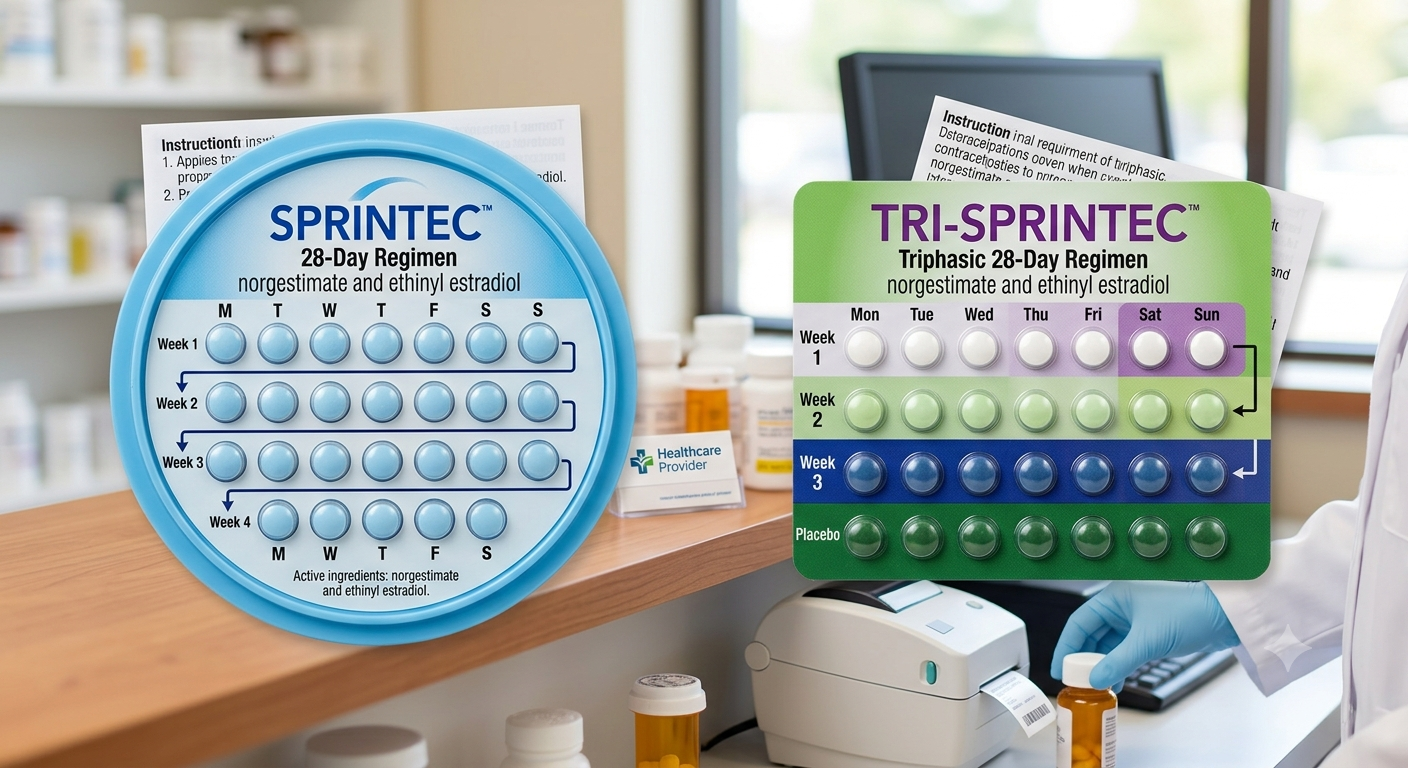
What Are Sprintec and Tri-Sprintec?
Sprintec and Tri-Sprintec are both combination oral contraceptive pills containing the same two active hormones — norgestimate, a progestin, and ethinyl estradiol, a synthetic estrogen. Both are FDA-approved for preventing pregnancy, and Tri-Sprintec carries an additional FDA approval for treating moderate acne in females aged 15 and older who have started menstruating and are using oral contraception.
Both medications are manufactured by Teva Pharmaceuticals. Sprintec is the generic form of the brand-name pill Ortho-Cyclen, while Tri-Sprintec is the generic form of Ortho Tri-Cyclen. Despite containing the same two hormones, the way those hormones are dosed throughout the monthly cycle is fundamentally different between the two — and this difference has real implications for how each pill feels and performs for different women.
The Core Difference: Monophasic vs Triphasic
The single most important distinction between Sprintec and Tri-Sprintec is their dosing structure.
Sprintec is a monophasic pill, meaning every active tablet in the pack contains exactly the same dose of hormones — 0.25 mg norgestimate and 0.035 mg ethinyl estradiol. The hormone level stays completely constant throughout the 21 active days of the cycle, with no variation from one pill to the next.
Tri-Sprintec is a triphasic pill, meaning the hormone dose changes three times across the 21 active tablets in the pack. The ethinyl estradiol dose remains fixed at 0.035 mg throughout, but the norgestimate dose increases in three steps: 0.180 mg for the first seven days, 0.215 mg for the next seven days, and 0.250 mg for the final seven days. This graduated hormone structure is designed to more closely mimic the natural rise and fall of hormone levels across a typical menstrual cycle.
Both pills follow the same 28-day schedule — 21 active hormone-containing tablets followed by 7 placebo tablets — and both are taken once daily.
How Both Pills Prevent Pregnancy
Sprintec and Tri-Sprintec use the same three mechanisms to prevent pregnancy, working together to create a highly effective contraceptive barrier.
The primary mechanism is suppression of ovulation. The estrogen and progestin combination suppresses the release of follicle-stimulating hormone (FSH) and luteinizing hormone (LH) from the pituitary gland, preventing the ovary from releasing an egg. Without ovulation, pregnancy cannot occur.
The second mechanism involves cervical mucus. Progestin thickens the mucus at the cervix, making it significantly more difficult for sperm to penetrate and reach any egg that might have been released.
The third mechanism affects the uterine lining. Both hormones alter the endometrium — the lining of the uterus — making it less receptive to implantation of a fertilized egg even in the unlikely event that fertilization occurs.
Together, these three mechanisms make both pills more than 99% effective when taken correctly and consistently.
FDA-Approved Uses
Both Sprintec and Tri-Sprintec are FDA-approved for pregnancy prevention. Tri-Sprintec carries the additional FDA approval for treating moderate acne vulgaris in females at least 15 years old who have started menstruating and who are choosing an oral contraceptive for birth control purposes.
Beyond their official FDA indications, both pills are commonly used off-label for several additional purposes that are well established in clinical practice. These include regulating irregular menstrual cycles, reducing heavy or painful periods, managing premenstrual syndrome symptoms, and decreasing the risk of ovarian cysts. Both pills have also been shown to reduce the risk of certain cancers including ovarian and endometrial cancer with long-term use.
Comparing the Two Side by Side
Understanding exactly how Sprintec and Tri-Sprintec compare across key areas helps clarify which option might be better suited to a particular person.
Hormone levels: Sprintec delivers a consistent 0.25 mg norgestimate dose throughout the cycle. Tri-Sprintec starts at a lower 0.180 mg and gradually increases to 0.250 mg. The estrogen dose is identical in both at 0.035 mg throughout.
Bleeding pattern: Some women find that the consistent hormone level in Sprintec produces more predictable, regular withdrawal bleeding during the placebo week. Tri-Sprintec’s changing hormone levels can lead to lighter or more variable bleeding for some users, and may cause more breakthrough bleeding for others, particularly in the first few months of use.
Acne treatment: Tri-Sprintec has the FDA nod for acne treatment. Sprintec is not specifically FDA-approved for this indication, though the hormone combination it contains may still have some beneficial effect on acne for some users.
Side effects: Both pills share the same common side effect profile. The most frequently reported side effects include nausea, headache, breast tenderness, mood changes, and breakthrough bleeding, particularly during the first two to three months of use while the body adjusts. These side effects are typically mild and tend to improve after the first few cycles.
Serious risks: Both carry the same serious risk warnings, including a small increased risk of blood clots, stroke, and heart attack. These risks are significantly higher in women who smoke, particularly those over 35, and both medications are contraindicated in women who smoke and are over 35 years of age.
Common Side Effects of Both Pills
The majority of side effects associated with Sprintec and Tri-Sprintec are mild and temporary, particularly in the first two to three months of use as the body adjusts to the hormonal shift.
Nausea is one of the most commonly reported early side effects and can usually be minimized by taking the pill with food or at bedtime rather than on an empty stomach in the morning.
Breast tenderness or swelling typically eases after the first one to two cycles. Headaches are reported by some users, particularly around the time of the placebo week. Mood changes including mild depression, irritability, or emotional sensitivity affect some users and are worth monitoring, particularly in women with a history of depression.
Breakthrough bleeding — spotting or light bleeding between periods — is common during the first few cycles on either pill, particularly with Tri-Sprintec due to the changing hormone levels. Most users find this resolves within two to three months of consistent use.
Weight changes, decreased libido, and contact lens intolerance due to fluid retention affecting the shape of the eye are less commonly reported but worth being aware of.
Serious Risks and Warning Signs
Both Sprintec and Tri-Sprintec carry the same serious risk warnings that apply to all combined oral contraceptives. These serious complications are uncommon but require prompt medical attention if symptoms appear.
Blood clots — including deep vein thrombosis in the legs and pulmonary embolism in the lungs — represent the most clinically significant serious risk. Symptoms of a leg blood clot include leg pain, swelling, warmth, or redness. A pulmonary embolism may present as sudden shortness of breath, chest pain, or a rapid heartbeat.
Stroke warning signs include sudden numbness or weakness, especially on one side of the body, sudden confusion, difficulty speaking, trouble seeing, severe headache with no known cause, or difficulty walking. Heart attack symptoms include chest pain, pressure or squeezing sensation, pain radiating to the arm or jaw, sweating, nausea, and dizziness.
If any of these symptoms occur, seek emergency medical care immediately rather than waiting to see if symptoms resolve.
Who Should Not Take These Pills
Both Sprintec and Tri-Sprintec are contraindicated in certain groups of women due to significantly elevated risk of serious complications.
Women who smoke and are over 35 should not use either pill. The combination of estrogen-containing oral contraceptives with smoking dramatically increases the risk of blood clots, stroke, and heart attack in this group specifically.
Additional contraindications include a history of blood clots or clotting disorders, history of stroke or heart attack, uncontrolled high blood pressure, severe migraines with aura, certain types of liver disease or liver tumors, known or suspected hormone-sensitive cancers, and current or suspected pregnancy.
Women with a history of depression, diabetes, or high cholesterol should discuss these conditions with their prescriber before starting either pill, since they may require closer monitoring.
Drug Interactions to Know
Both pills interact with several medications that can reduce their effectiveness, potentially leading to unintended pregnancy. Medications known to reduce hormone levels and contraceptive effectiveness include certain anticonvulsants used to treat seizures, rifamycin antibiotics, HIV medications, antifungals including griseofulvin, modafinil, and St. John’s Wort herbal supplement.
Conversely, certain medications increase hormone blood levels when taken alongside these pills, including acetaminophen in high doses, vitamin C, atorvastatin, and azole antifungals.
Always inform any prescriber or pharmacist about all medications, supplements, and herbal products you are taking before starting either Sprintec or Tri-Sprintec.
How to Take Sprintec and Tri-Sprintec Correctly
Both pills follow the same general schedule: one active tablet taken at the same time every day for 21 consecutive days, followed by one inactive placebo tablet daily for the remaining 7 days of the 28-day pack. The placebo days allow for withdrawal bleeding while maintaining the habit of daily pill-taking.
Taking the pill at the same time every day is important for maintaining consistent hormone levels and maximizing effectiveness. Setting a daily alarm or linking pill-taking to an existing daily habit — brushing teeth, eating breakfast — significantly reduces missed doses.
Because Tri-Sprintec uses a triphasic hormone structure, the order of the tablets matters. They must be taken in the correct sequence as arranged in the blister pack. Unlike monophasic Sprintec where every active tablet is identical, accidentally taking a Tri-Sprintec tablet out of sequence means you receive the wrong hormone dose for that point in your cycle.
Neither pill protects against sexually transmitted infections including HIV. A barrier method should be used alongside the pill when STI protection is needed.
Which One Should You Choose?
The choice between Sprintec and Tri-Sprintec is a decision best made with a healthcare provider who knows your full medical history, but there are some general patterns worth understanding.
Sprintec’s consistent hormone level throughout the cycle tends to appeal to women who prefer simplicity — every active pill is identical, so there is no need to track which phase you are in. The steady hormones can also produce more predictable, regular withdrawal bleeding for some users. For women who have previously done well on monophasic pills or who are starting hormonal contraception for the first time, Sprintec is often a straightforward starting point.
Tri-Sprintec’s triphasic design is sometimes preferred by women who experience more pronounced side effects on higher fixed-dose pills, since the lower starting dose of progestin in the first week may be gentler for some users. The FDA approval for acne treatment makes Tri-Sprintec the appropriate choice when treating moderate acne is a concurrent goal alongside contraception.
For some women, side effect experiences differ meaningfully between the two — one may cause less nausea, fewer mood effects, or better cycle regularity than the other for a specific individual. If the first choice doesn’t suit you after a full two to three cycle trial, switching to the other is a reasonable next step worth discussing with your provider.
Cost and Availability
Both Sprintec and Tri-Sprintec are available as generics at major pharmacies and are covered by most insurance plans and through Medicaid. For uninsured patients, generic birth control pills including both of these options are available at significantly reduced cost through programs like Planned Parenthood, federally qualified health centers, and discount pharmacy programs. GoodRx and similar tools can also significantly reduce out-of-pocket cost at retail pharmacies when insurance coverage is not available.
FAQs About Sprintec and Tri-Sprintec
Q1: What is the main difference between Sprintec and Tri-Sprintec?
Sprintec is monophasic, meaning every active tablet contains the same hormone dose throughout the cycle. Tri-Sprintec is triphasic, meaning the progestin dose increases in three steps across the 21 active tablets to more closely mimic the natural hormonal fluctuations of the menstrual cycle. Both contain the same two hormones — norgestimate and ethinyl estradiol — in the same brand-name formulations they were each originally developed as.
Q2: Is Tri-Sprintec better than Sprintec for acne?
Tri-Sprintec is specifically FDA-approved for treating moderate acne in eligible patients, while Sprintec does not carry this specific FDA indication. For women choosing an oral contraceptive partly to address acne, Tri-Sprintec is the appropriate choice between the two.
Q3: Can you switch between Sprintec and Tri-Sprintec?
Yes, but switching should be done under the guidance of a prescriber who can advise on timing and whether a backup method of contraception is needed during the transition. The two pills are not interchangeable as generic substitutes for each other since they have different brand-name originals and different dosing structures.
Q4: Are there any differences in how effective Sprintec and Tri-Sprintec are at preventing pregnancy?
Both are greater than 99% effective at preventing pregnancy when taken correctly and consistently. There is no clinically meaningful difference in contraceptive effectiveness between the two when used as directed.
Q5: What should I do if I miss a dose?
For Sprintec, missing one pill is less complicated since all active tablets are identical. For Tri-Sprintec, missing a pill requires careful attention to which phase of the cycle you are in, since taking tablets out of sequence means receiving the wrong hormone dose. Follow the specific missed-dose instructions included in your pill pack or contact your pharmacist or prescriber for guidance, and consider using a backup contraceptive method until you confirm you are back on track.
Q6: Can either pill be used while breastfeeding?
Both Sprintec and Tri-Sprintec pass into breast milk and may affect milk production and have effects on a nursing infant. Estrogen-containing combination pills are generally not recommended during breastfeeding. A progestin-only pill is typically the preferred oral contraceptive option for breastfeeding women — discuss this with your healthcare provider.
Q7: Do Sprintec or Tri-Sprintec protect against STIs?
No. Neither pill provides any protection against sexually transmitted infections including HIV. A barrier method such as a condom should be used alongside either pill when STI protection is needed.
Q8: How long does it take for either pill to become effective?
When started on the first day of your menstrual period, both pills provide immediate contraceptive protection. When started at any other point in the cycle, a backup method of contraception should be used for the first seven days. Your prescriber will advise on the specific start timing and backup method requirements based on where you are in your cycle when you begin.
If you found this article helpful, you might also enjoy exploring more content from our blog. We regularly publish guides, tips, and insights across a variety of topics to help you stay informed and make better decisions. Feel free to check out our other articles and let us know what you’d like us to write about next.